
[ad_1]
You must have heard of Wi-Fi 7 — the standard that comes after Wi-Fi 6E. There has been a lot of buzz about it since the end of 2021.
And in late February 2022, Qualcomm announced the first chip supporting the standard, the FastConnect 7800, effectively turning Wi-Fi 7 into a real thing that’s officially on the horizon. You can expect more vendors to follow suit this year.
While exciting, the new wireless standard is not intended to and will not “replace Ethernet,” as you might have read somewhere. Wi-Fi would never replace wired connections, both in performance and reliability. They are just two different things.
Wi-Fi and Duplex
Wi-Fi is always Half-Duplex: Data moves in one direction at a time. You can think of Wi-Fi as the walkie-talkie in voice communication.
Wired connection is (generally) Full-Duplex: Data travel both ways simultaneously. That’s similar to a phone call in voice communication.
You’ll find more information below, but to cut to the chase, it’ll be another year or so before you can purchase a Wi-Fi 7 router, and it might be even longer until you can get your device to support it. Think 2023.
In the meantime, and even when Wi-Fi 7 is officially available, your existing equipment of current standards will remain relevant.
Dong’s note: I first published this post on November 19, 2021, and last updated it on April 8, 2022, with up-to-date information on the new Wi-Fi standard.

What is Wi-Fi 7
The name alone is telling. It’s the 7th generation of Wi-Fi, the most common way to connect local devices locally and, hence, to the Internet.
Technically, Wi-Fi 7 is the friendly name of the 802.11be standard, just like Wi-Fi 6 to 802.11ax, Wi-Fi 5 to 802.11ac, etc. It’s much easier to remember that 7 comes after and is “better” than 6.
Like all previous Wi-Fi standards, Wi-Fi 7 will be backward compatible. In other words, your existing devices will be able to connect to a Wi-Fi 7 broadcaster (router or access point), and so will a Wi-Fi 7 client to a host of an older standard.
But, again, to truly enjoy the benefit of Wi-Fi 7, you likely will need new hardware on both ends of a connection. And on some computers, you might be able to do that via an add-on adapter — like how you can upgrade many existing computers to Wi-Fi 6 or Wi-Fi 6E.
With that, let’s find out what will make Wi-Fi 7 different from existing standards.
Wi-Fi 7 vs Wi-Fi 6 (E): Four key items to turn it a game-changer
In many ways, Wi-Fi 7 is the combo of Wi-Fi 6 and Wi-Fi 6E. It also uses all three bands, including 2.4GHz, 5GHz, and 6GHz.
The 6GHz band is still where the latest standard can deliver top speeds, but Wi-Fi 7 will also provide unprecedented improvements in the other two bands.
However, keep in mind that Wi-Fi 7 shares similar theoretical ranges as existing standards that use the same frequencies. But as a smarter standard, it can be more efficient in all counts, resulting in a longer effective range. But that remains to be seen.
Other than that, there are four important and exciting new items in Wi-Fi 7.
1. The all-new 320MHz channel width
The first is the new and much wider channel width, up to 320MHz or double that of Wi-Fi 6/E.
Organically, this new channel width is only available on the 6GHz band, with up to three 320MHz channels. However, Wi-Fi 7 can combine portions of the 6GHz and 5GHz bands to create this new bandwidth — more on this in the Multi-Link Operation section below.
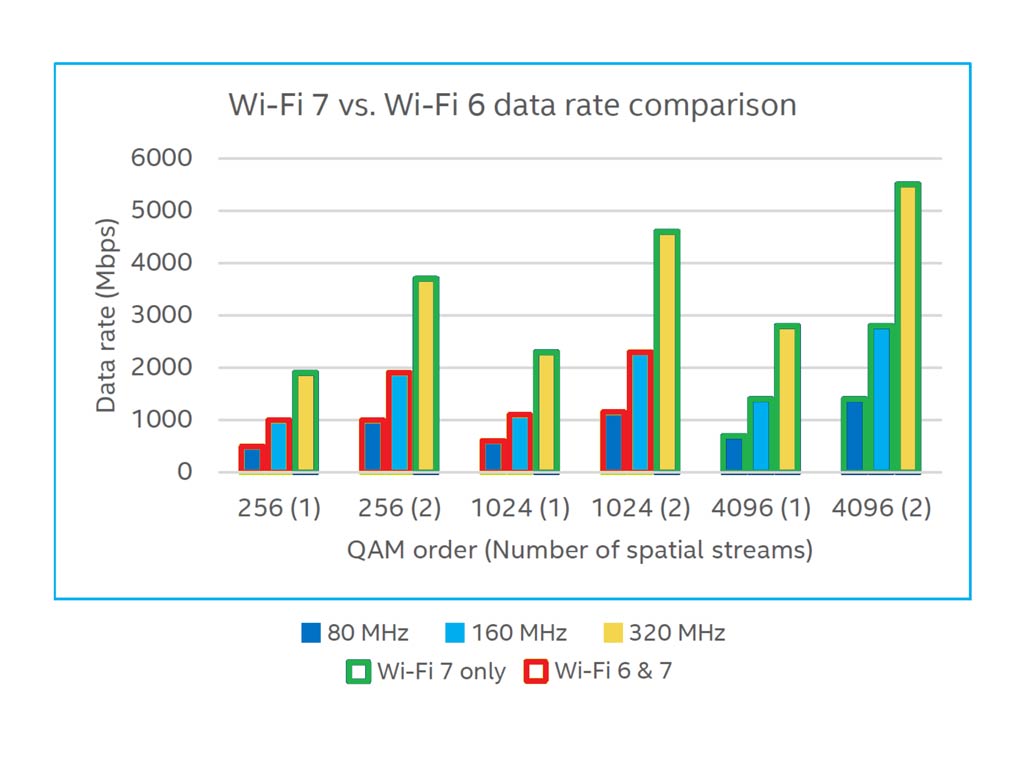
I talked about Wi-Fi channels in this post, but generally, the higher bandwidth means Wi-Fi 7 can double the base speed, from 1.2Gbps per stream (160MHz) to 2.4Gbps per stream (320MHz).
So, in theory, a 4×4 broadcaster 6GHz Wi-Fi 7 can have up to 9.6 Gbps of bandwidth — or 10Gbps when rounded up. In reality, depending on the actual configuration, Wi-Fi 6 routers and access points will be available in different speed grades, including those offering bandwidths higher than 10Gbps on the 6GHz band.
Wi-Fi 7 also supports double the amount of partial streams, up to 16. As a result, technically, a 16-stream (16×16) Wi-Fi 7 6GHz band can deliver up to over 40Gbps of bandwidth, especially when considering the new QAM support below.
Again, to use the new 320MHz channel width, you will need a compatible client. Existing clients will connect using 160MHz at best. And in reality, the 160MHz will likely be the realistic sweet-spot bandwidth of Wi-Fi 7, just like the 80MHz in the case of Wi-Fi 6.
2. The 4K-QAM
QAM or quadrature amplitude modulation is a way to manipulate the radio wave to pack more information in the Hertz.
Wi-Fi 6 supports 1024-QAM, which itself is already impressive. However, Wi-Fi 7 will have four times that, or 4096-QAM. Greater QAM is always better.
As a result, Wi-Fi 7 will have a much higher speed and efficiency than previous standards when working with supported clients.
| Wi-Fi 6/E | Wi-Fi 7 | |
| Max Channel Bandwidth |
160MHz (Up to 3 on the 5GHz band and 7 on the 6GHz band) |
320MHz (Up to 3 channels on the 6GHz band) |
| Highest Modulation Order | 1024-QAM | 4096-QAM |
| Max Number of Spatial Streams |
8 | 16 |
| Max Bandwidth Per Stream |
1200Mbps (160MHz) |
2400Mbps (320MHz) |
| Theoretical Full Band Bandwidth | 9.6Gbps (8×8) |
46.1Gbps (16×16) |
3. Multi-Link Operation
Multi-Link Operation or MLO is the most exciting and promising feature of Wi-Fi 7.
In a nutshell, MLO is Wi-Fi band aggregation. Like Link Aggregation (or bonding) in wired networking, MLO allows combining two Wi-Fi bands, 5GHz and 6GHz, into a single Wi-Fi network/connection.
The bonded link is also available in two modes: load balance or failover.
The former allows for combining the bandwidth of both bands into a single link. It’s excellent for those wanting to get the fastest possible wireless speed but requires support on the client end to work.
The latter, however, only requires support from the broadcasting side and can be a game-changer in a wireless mesh setup. With failover MLO, we can potentially count on having no signal drop or brief disconnection. And it’s also when seamless handoff (or roaming) can become truly seamless.
On top of that, on each band, a connection can also intelligently pick the best channel, or channel width, in real-time. In other words, it can channel-hop, just like Bluetooth, though likely less frequently.
(Up to Wi-Fi 6E, a Wi-Fi connection between two direct devices takes place in a single band, using a fixed channel, at a time.)
This new capability will help increase the efficiency of Wi-Fi 7’s range, allowing all of its bands to deliver faster speed over longer distances than previous standards.
In more ways than one, MLO is the best alternative to the existing so-called “Smart Connect” — using the same SSID (network name) and password for all the bands of a broadcaster — which doesn’t always work as smartly as expected.
Clearly, how MLO pans out remains to be seen but there seems to be no downside to this new capability.
4. Automated Frequency Coordination
Automated Frequency Coordination (AFC) applies mostly to outdoor 6GHz Wi-Fi applications.
In an open environment, there can be existing applications that already use the spectrum. For example, fixed satellite services (FSS) or broadcast companies might have already had licenses to use certain parts of the band.
As a newcomer, Wi-Fi (6E and 7) must not impact those existing services — a concept similar to the use of DFS channels in the 5GHz band.
That’s when AFC comes into play. The idea is that all new 6GHz broadcasters check with a registered database in real-time to confirm that their operation will not negatively impact other registered members, including other Wi-Fi 6E or Wi-Fi 7 broadcasters.
The support for AFC means each Wi-Fi 7 broadcaster will have its own free airspace to operate, meaning vendors can use more power and more flexible antenna designs.
In short, AFC compliance will help a Wi-Fi broadcaster improve range and connection speeds by preemptively creating “private” airspace dependent on the current real-world situation, in which it can operate without the constraint of regulations.
Other improvements
On top of that, Wi-Fi 7 will also have the support for Multi Resource Unit or Multi-RU. Multi-RU is part of the behind-the-scene technologies that increase the efficiency of Wi-Fi, which also includes MU-MIMO and OFDMA.
In Wi-Fi 7, Multi-RU is created by “puncturing the operating channel using the 20MHz granularity”. That’s very technical, but the point is to actively avoid transmitting on frequencies that are locally saturated or unauthorized by regulations.
Other than Wi-Fi itself, my take is that the support for Multi-Gig wired networking, specifically 10Gbps network ports, will be commonplace in Wi-Fi 7 routers and access points.
Multi-Gig has to be common since the wireless speeds have gotten are too great for the good old Gigabit standard. And wired Multi-Gig is great — it’s the way of the future.
The takeaway
Wi-Fi 7 seems to combine the fragmentations in Wi-Fi 6 and Wi-Fi 6e to form a uniform approach to Wi-Fi that deliver faster speeds and truly reliable connectivity.
The new standard promises improvements in all aspects of Wi-Fi, including throughputs, connection quality, and range. Finally, we might have a Wi-Fi connection that can genuinely deliver Multi-Gig or even 10Gbps Internet.
But, again, it will be at least another year, likely longer, before consumer-grade devices are available to purchase. Optimistically, think late 2023. And even then, the device you get might not support all features or speeds the new standard potentially has.
Wi-Fi 7 will materialize gradually, with the real-world performance expected to be worse than the hype, and the use of mix-standard hardware will continue to be a sure thing.
That has been the case with all Wi-Fi revisions. Come to think about it, it’s been over three years since Wi-Fi 6 became commercially available, yet today we still don’t even have clients faster than dual-stream (2×2). And don’t get me started on Wi-Fi 6E.
As a rule, it’s never a good idea to wait for the latest and greatest. When it comes to getting connected, the availability of the connectivity needed is always more important than the connection method.
The point is that you should buy a Wi-Fi solution that best fits your needs today. Wi-Fi 7, for now, is still a matter of tomorrow. Once it’s here, it’ll stay — we can always upgrade to it in due time.
[ad_2]
Source link
About the Author


