
[ad_1]
This post will work you through the steps to set up a Multi-Gig wired backhaul AiMesh system using a few supported broadcasters. As you can see in the box below, it’s part of my series on Asus’s AiMesh.
Also, keep in mind that Multi-Gig is still a luxury right now — you’re getting into the territory that can be more expensive than necessary. You can feel that from the cost of the latest Orbi RBK960 series from Netgear.
Going the AiMesh route might not dig as big of a hole in your wallet, but it still doesn’t apply to the budget-minded.
In any case, ensure you have gotten your home wired — we’re talking most about wired networking here. Also, make sure you brush up on what Multi-Gig means.
Dong’s note: I first published this post on October 29, 2021, and since then, I have tested more Multi-Gig combos. This update, posted on June 27, 2022, aims to reflect that.
Multi-Gig wired backhauling: The why
Originally, the “mesh” notion in a Wi-Fi network means that you have multiple broadcasters linked together wirelessly. That’s still true today –I mentioned that in this primer post on the topic.
Generally, when you use multiple Wi-Fi broadcasters — like in the case of a mesh network that includes a primary router and satellite unit(s) — there are two types of connections: fronthaul and backhaul.
Fronthaul is the Wi-Fi signal a mesh hub broadcasts outward for clients or its network ports for wired devices. That’s what we generally expect from any Wi-Fi broadcaster.
On the other hand, backhaul, a.k.a backbone, is the link between one broadcasting unit and another, be it the primary router or another satellite unit.
This link works behind the scene to keep the mesh hardware units together as a system. It also determines the ceiling speed of all devices connected to a satellite unit.
But this wireless backhaul link has many issues, including slow speeds due to signal loss/degradation and unreliability due to the elements. That’s just the nature of any wireless connection.
And this is where wired backhauling comes into play. Still, some online “experts” have scolded me that using network cables negates the mesh notion. “It’s not a mesh anymore!” they say, and they might be right.
But I’m not about being right. In my experience, wired backhauling is the best way to build a (mesh) Wi-Fi system. Take “mesh” out if that suits you.
Most importantly, if you need true Gigabit (1Gbps) or faster connections, no wireless backhaul link can handle that reliably. In this case, using Multi-Gig wired backhauling is the only way.
And that’s why I maintain this post, in addition to the previous one on getting the best (sub-Gigabit) AiMesh combo.
With that, let’s move on to the best Multi-Gig wired AiMesh combos we can get today.
Asus Multi-Gig wired backhaul AiMesh combos: Everything you need to know
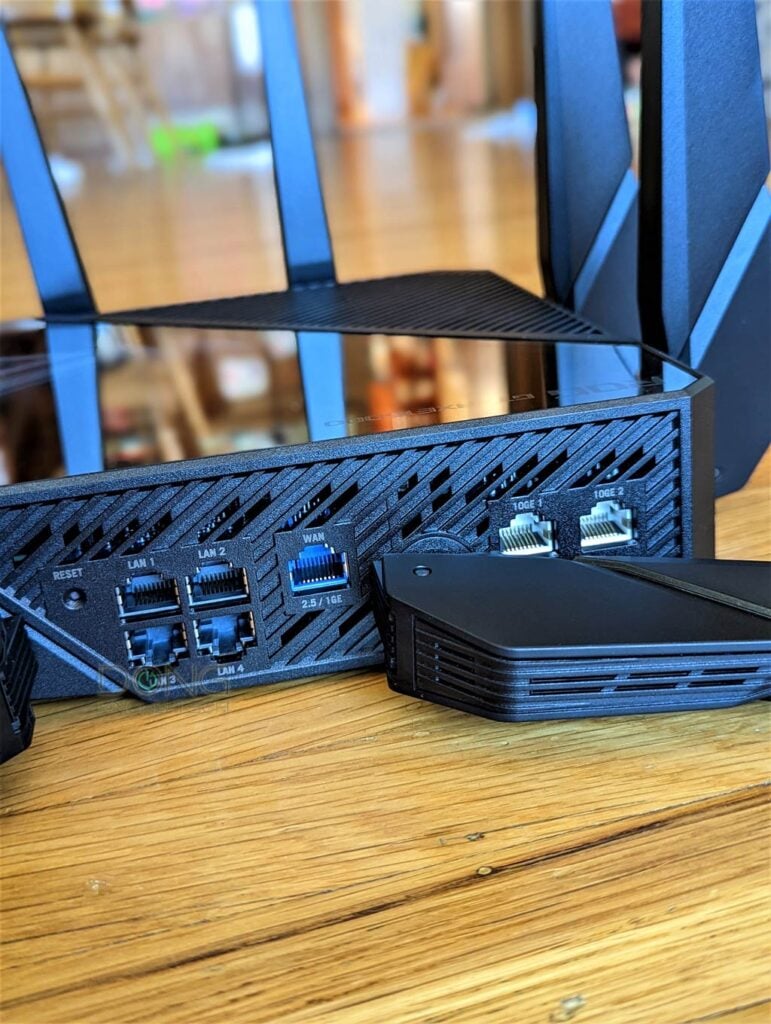
In early 2022, with the releases of the ZenWiFi Pro ET12 and GT-AX6000, both have two 2.5Gbps ports, we’ve had a decent selection of AiMesh options that can handle Multi-Gig wired backhaul.
And things got better as the year progressed. In early June, I published the review of the GT-AXE16000, which has three Multi-Gig ports (two are 10Gbps). There’s also the GT-AX11000 Pro down the line.
The point is: It’s safe to say from here on out that there’ll be more and more Multi-Gig wired options within Asus’s AiMesh ecosystem.
Multi-Gig wired backhaul sweet spot: 2.5Gbps on the satellite
When it comes to a wired Multi-Gig network, 10Gbps is the fastest speed grade, and it never hurts to have it. However, in a mesh network, it makes sense to use satellites with the lowest grade of Multi-Gig, which is 2.5gbps.
That’s because the fastest Wi-Fi connection (2×2 Wi-Fi 6/6E at 160MHz) has sustained speeds of around 1.5Gbps at best. As a result, there’s generally no benefit in performance when the intake port of a satellite is faster than 2.5Gbps.

Again, it doesn’t hurt to use 10Gbps-enabled hardware throughout a mesh system, but generally, there’s no return on investment in this case. on the Wi-Fi front. For wired clients, it’s better to use a Multi-Gig switch.
Rules on using Asus wired hardware
With wired backhaul — that’s when you use network cables to link the hardware units — it’s generally a good idea to avoid using traditional Tri-band hardware.
This type of Tri-band broadcaster comes with an additional 5GHz-2 band, like the ZenWiFi XT8, GT-AX11000, or the ZenWiFi Pro XT12.
While they all work in a wired configuration, they are designed for a fully wireless environment, where the 5GHz-2 band functions as the dedicated backhaul.
Consequently, they might have unexpected issues when using network cables to link them. Furthermore, this Tri-band provides no added benefits in a wired home, despite the comparatively higher costs.
That said, for a fully wired system, especially one with Multi-Gig speed grades, it’s best to use Dual-band Wi-Fi 6 or Tri-band Wi-Fi 6E broadcasters.
Finally, generally, it’s not a good idea to mix Wi-Fi 6 and Wi-Fi 6E hardware in a mesh system.

Note how its 6GHz band is not available to clients — it’s there, but you can’t configure it. That’s why it’s not a good idea to mix Wi-Fi 6 and Wi-Fi 6E in an AiMesh setup. But if you insist on using these broadcasters together, there’s a way to make their 3rd band work — more below.
With that, let’s check out the list of the current hardware we can use right now. You’ll note that I skip all Tri-band Wi-Fi 6 routers.
Multi-Gig AiMesh combos: The current hardware and real-world combos
In an AiMesh setup, we have the main router and satellite nodes.
Ideally, the router should have two Multi-Gig ports — one for the broadband (WAN) and the other for the local network (LAN). However, we only need Multi-Gig on the LAN side for a home with sub-Gigabit broadband. But it never hurts to have Multi-Gig on both the WAN and LAN sides.
The hardware only needs one Multi-Gig port for the satellite, though having a second Multi-Gig port means you can add a Multi-Gig device, like a server, to it.
In short, it never hurts to have more Multi-Gig ports. But for now, two per device are the most we can have. If you want more than that, you need to get a switch.
The table below includes all current hardware that can work as a Multi-Gig wired AiMesh router, satellite, or both.
| Router | Multi-Gig Ports | AiMesh Roles | Note |
| RT-AX86U | 1x 2.5Gbps LAN | Router or satellite | The router role is only suitable for homes with sub-Gigabit broadband |
| RT-AX89X | 1x 10Gbps Multi-Gig 1x 10Gbps SFP+ |
Router or Satellite | An SFP+-ready Multi-Gig switch is needed for homes with Gig+ or faster broadband unless the SFP+ port can be used for WAN connection |
| GT-AXE16000 | 1x 2.5Gbps WAN/LAN 2x 10Gbps LAN/WAN |
Router or Satellite | The ultimate AiMesh hardware with Multi-Gig (up to 10Gbps out of the box) wired backhauling |
| GT-AXE11000 | 1x 2.5Gbps LAN/WAN | Router or Satellite | The router role is only suitable for homes with sub-Gigabit broadband |
| GT-AX6000 | 1x 2.5Gbps WAN 1x 2.5Gbps LAN |
Router or Satellite | Ready for Multi-Gig out of the box |
| ZenWiFi Pro ET12 | 1x 2.5Gbps WAN 1x 2.5Gbps LAN |
Router or Satellite | Ready for Multi-Gig out of the box |
| ZenWiFi ET8 | 1x 2.5Gbps WAN | Satellite | No Multi-Gig LAN option as a router |
Generally, you can use any combination of the above routers to get a system with Multi-Gig wired backhaul. I’ve tried most of the possible combos, and they all work.
However, some combos are better than others. Below are those I’ve used with success for an extended amount of time and tips on setting them up.
The Ultimate Tri-band Wi-Fi 6E Multi-Gi AiMesh Combos: GT-AXE16000 as the primary router
The GT-AXE16000 has everything one would look for in a standalone router. And thanks to its three Multi-Gig ports, it’ll also make an excellent AiMesh router.
While you can get multiple units to have a mesh system with 10Gbps wired backhauling, that’d not make sense financially considering the sweet spot note above.
That said, it’s best to use it as the primary router and 2.5Gbps-enabled hardware as satellites.
The best performance option: GT-AXE16000 as primary router + ZenWiFi Pro ET12 as satellite(s)
GT-AXE16000 + a ZenWiFi Pro ET12 (or a 2-pack) is the best wired backhauling AiMesh combo.
The router can handle two Multi-Gig satellites on its own, but you can also daisy-chain the hardware — no switch is needed. But depending on the house’s layout, a switch might be necessary when you want to place the satellite where the original cable can’t reach.

In any case, you’ll get the full gaming features from the primary router, the best performance throughout, and the fancy lighting of the hardware doesn’t hurt.
That said, here are the detailed steps (all done within the web user interface of the GT-AXE16000):
- Set up the GT-AXE16000 as a standalone router. Depending on your broadband speed, you can use any of its ports, 1Gbps, 2.5Gbps, or 10Gbps, as the WAN port. Upgrade the router to the latest firmware (when available).
- Optional: Connect a Multi-Gig unmanaged switch to the router’s applicable Multi-Gig port (2.5Gbps or 10Gbps.)
- Add a ZenWiFi Pro ET12 as a wireless satellite node. (Detailed steps in this post on AiMesh.) Important: If you use a 2-pack ET12, keep the other ET12 unit off during this process.
- Repeat step #4 above to add the second ET12 to the mesh.
- Connect the ET12(s) to the main router’s Multi-Gig port(s) using their 2.5Gbps WAN port. You can daisy-chain them or use a Multi-Gig switch in between.
- Open the AiMesh section of the GT-AXE16000. Change the backhaul to prioritize the 2.5Gbps port for each satellite, and turn on the GT-AXE16000’s Ethernet Backhaul Mode. Manually restart all the hardware units.
And that’s it. Your mesh is ready.
The more affordable option: GT-AXE16000 as primary router + ZenWiFi ET8 as satellite(s)
The ZenWiFi ET8 is also available as a 2-pack.
This combo might require a switch if you want to use both ET8 units with Multi-Gig wired backhaul — you can’t daisy-chain them since each has just one 2.5Gbps port. In this case, the Zyxel MG-108 is an excellent fit.
But in most cases, you can plug them directly into the GT-AXE16000’s Multi-Gig ports.
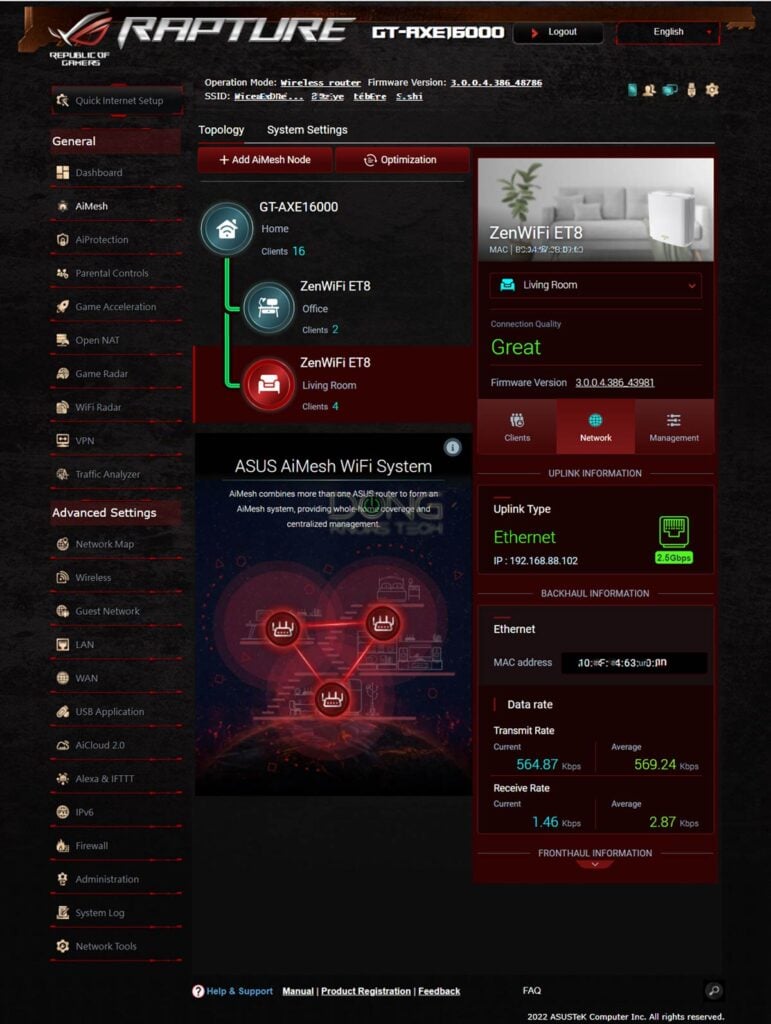
The setup steps are similar to the case of the ET12 above (all done within the router’s web user interface):
- Set up the GT-AXE16000 as a standalone router. Upgrade it to the latest firmware (if applicable).
- Connect a Multi-Gig unmanaged switch to the router’s 2.5Gbps LAN port (optional.)
- Add the first ET8 as a wireless satellite node. (Detailed steps in this post on AiMesh.) Important: Make sure you do not turn on the other ET8 unit this time.
- Repeat step #3 to add the second ET8 unit.
- Connect both ET8 units into power and connect their WAN port to the network, directly to the router or the Multi-Gig switch.
- Open the AiMesh section of the GT-AXE16000. Change the backhaul to prioritize the 2.5Gbps port for each satellite, and turn on the GT-AXE16000’s Ethernet Backhaul Mode. Manually restart all the hardware units.
Best standard Tri-band Wi-Fi 6E Multi-Gig wired backhaul AiMesh: The ZenWi-Fi Pro ET12
The ZenWiFi Pro ET12 is the readiest Multi-Gig system you can find. The system is currently available as a 2-pack, and it’s ready right out of the box.
All you have to do is set up one unit as the primary (or standalone) router. After that, connect the second unit’s WAN port to the router’s 2.5Gbps LAN port using a network cable, and your Multi-Gig system is ready.

Since each unit has two 2.5Gbps ports, you’ll get Mult-Gig on both the WAN and LAN side. What’s more, if you get more units, you can daisy-chain them without a Multi-Gig switch.
Best standard Dual-band Wi-Fi 6 Multi-Gig wired backhaul AiMesh combo: RT-AX89X + RT-AX86U
You can have a Multi-Gig wired backhaul mesh system right away when using this combo. But if you want to use two RT-AX86U satellite nodes, you’d need a Multi-Gig switch.
A switch with an SFP+ uplink port will also come in handy if you have a Gig+ or faster broadband that requires the router’s 10Gbps BASE-T port. In this case, the Zyxel XGS1250-12 is a good option.
(You can also consider the TP-Link TL-SX1008 or the Zyxel MG-108 if you don’t have Multi-Gig broadband or can use the router’s SFP+ for the WAN side.)

With that, here are the steps to build this Multi-Gig AiMesh system:
- Set up the RT-AX89X as a single router. Update it to the latest firmware.
- Add the RT-AX86U as a wireless node. (Detailed steps in this post on AiMesh.) Update it to the latest firmware using the router’s web interface.
- Open the AiMesh section of the RT-AX89X, select the node, and change the Backhaul Connection Priority to 2.5Gbps first.
- Now, plug the RT-AX86U’s 2.5Gbps port into the 10Gbps LAN port of the RT-AX89X or the Multi-Gig switch connected to that port.
- Repeat step #2 to add more satellite nodes if applicable. Turn on the router’s Ethernet Backhaul Mode. Manually restart all routers. Mission accomplished.

Alternatively use the RT-AX89X (router) + RT-AX89X (satellite) or GT-AX6000 (satellite). I haven’t tried these out extensively, but they worked, and the former is currently the only option for 10Gbps backhaul.
Best Gaming Dual-band Wi-Fi 6 Multi-Gig AiMesh Combos: GT-AX6000 as the primary router
With the GT-AX6000 as the primary router, you’ll get a network with all features and settings available to any Asus router, including those designed for gamers.
In this case, you can use any Dual-band routers for the satellites, including another GT-AX6000, RT-AX89X, or RT-AX86U. In all cases, you’d get a robust system with a 2.5Gbps wired backhaul.

Depending on the number of satellites, you might or might not need a Multi-Gig switch. But if you do, the Zyxel MG-108 is a good fit.
Extra: Mixed Wi-Fi 6 and Wi-Fi 6E Multi-Gig wired backhaul AiMesh combos
As mentioned above, you shouldn’t mix a Dual-band Wi-Fi 6 router with a Tri-band Wi-Fi 6E satellite.
That’s because AiMesh doesn’t have a practical way (yet) to control the node’s 3rd band. As a result, this band is not used, which is unacceptable.

But if you have mixed hardware like this for some reason, there’s a way to make the best out of them. Specifically, you can use the Tri-band Wi-Fi 6E hardware in the AP mode on top of another router.
That is not the best way to get a Multi-Gig wired backhaul AiMesh setup, but it will work quite well.
In this example, I used an RT-AX89X as the primary router and a 2-pack ZenWiFi ET8 as the satellite. However, the steps are similar if you use any Dual-band router — including a non-Asus one — as the primary router and any other Tri-band hardware as the satellite.
Here are the steps:
- Set up the RT-AX89X as a router.
- Connect a Multi-Gig switch to the router’s Multi-Gig LAN port.
- Set up the ET8s set as APs to the RT-AX89X. Two possibilities:
- If you get a 2-pack (pre-synced hardware):
- Connect the first ET8’s WAN port to the Multi-Gig switch.
- Open its web interface and choose the AP mode.
- Set up its Wi-Fi with the same SSID and password as the RT-AX89X. (You can use a different SSID for each band, especially the ET8’s 6GHz band.)
- Connect the 2nd ET8’s WAN port to the Multi-Gig switch. Mission accomplished. The 2-pack ET8 now automatically works as an AP-mode AiMesh system.
- If you get two ET8 units separately (they are not pre-synced):
- Set up the first ET8 as a router — use the same SSIDs and password as the router — then add the 2nd unit as a wireless node.
- Use the first ET8’s web interface to switch the operation role into the AP mode.
- Connect both ET8 units’ WAN ports to the Multi-Gig switch. Mission accomplished.
- If you get a 2-pack (pre-synced hardware):
And now you get a standalone router (the RT-AX89X) and an AiMesh running in the AP mode (the ET8).

In this case, you can not control the ET8 via the web interface (or mobile app) of the RT-AX89X. But in return, you can use all of the ET8’s bands and connect all hardware using Multi-Gig wired connections.
Hopefully, Asus will release firmware at some point that allows for better controlling of tri-band satellites via a dual-band router — which has been the case in Synology Mesh from the get-go. Until then, if you intend to use a dual-band router with tri-band satellites, this is the only way.
The takeaway
There you have it. These are possible options in Multi-Gig wired AiMesh systems that proved to work well in my extended hands-on trials.
As time goes by, there will be more hardware options, but the principles remain: You generally only want to use Dual-band Wi-Fi 6 and Tri-band Wi-Fi 6E together.
Again, traditional Tri-band hardware — those with an additional 5GHz band — might work, but it’s not ideal to use them in a wired backhaul setup.
[ad_2]
Source link
About the Author


