
[ad_1]
In The Shame Machine, mathematician Cathy O’Neil presents an anecdote about George Wallace, the racist governor of Alabama shot down by a would-be assassin, then visited in the hospital by Rep. Shirley Chisholm, a Black congresswoman. They were both running for president in 1972. Chisholm is a towering moral figure. Wallace is not.
Chisholm prayed with the paralyzed Wallace, O’Neil writes, despite the bitterness her staff felt at her kindness toward this vile man. Chisholm knew empathy, and that’s not the same as kindness. “I wouldn’t want what happened to you, to happen to anyone,” she told Wallace, in words no doubt powered by experience with threats against her own life.
Wallace lay there. Maybe then he felt shame for his past, shame drilling to the marrow.
The Shame Machine deftly and adeptly presents the scope of “shame,” that emotion we’ve all felt, be it public, hidden, ignored, or tormenting. O’Neil, author of the acclaimed Weapons of Math Destruction, examines that moral, righteous, right shame—the kind that Wallace might have felt under Chisholm’s soft eyes.
How George Wallace Harnessed Hate
There’s shame brought on by our failures to fit in to the norms of society, often appropriate—drunk driving, parking in a handicapped space, undertipping. Or, O’Neil describes, little people punching up to shame government inaction or corruption.
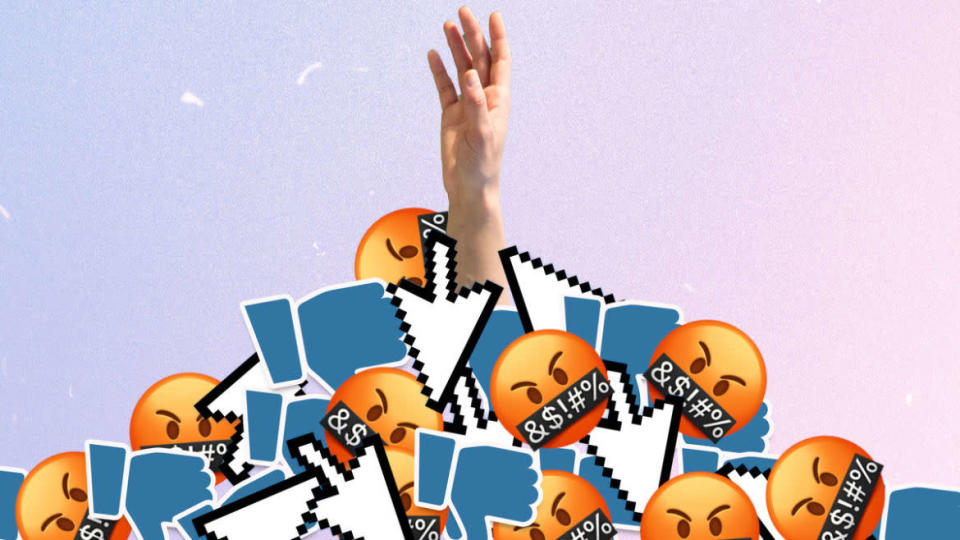
And there is shame pushed by social media’s algorithms that determine what gets boosted to ensure we see it: the shame machine that exploits our insecurities that we’re weak, ugly, unloved, and that those who violate our personal norms must be unlovable.
Throughout The Shame Machine, O’Neil dissects this manipulative shame caused by social media, how we deploy it, not with moral courage, but just the selfish satisfaction of being the loudest of the mob. Corporations punch down by firing an employee caught up in the internet hate-cycle; people turn their neighbors into pariahs, to feel righteous without ever changing their own beliefs.
Chisholm didn’t need to do that to shame Wallace. Her visit made Wallace work it out for himself.
In 1979, O’Neil writes, Wallace arrived at Dr. Martin Luther King’s Dexter Avenue Baptist Church, accompanied only by the attendant who pushed his wheelchair. Addressing the congregation of mostly-Black parishioners, he said, “I’ve learned what suffering means in a way that was impossible. I think I can understand something of the pain that Black people have come to endure. I know I contributed to that pain, and I can only ask for your forgiveness.”
Did Chisholm’s visit shame him into an attempt at redemption?
There must be a contemporary 1979 account of that church visit. Biographies and years-later anecdotes relate the visit, but I found no newspaper story from the time. No witnesses’ quotes, no Wallace press conference. It takes an act of faith to believe it happened.
Wallace was so ashamed that he arrived at the church of a modern martyr without cameras or entourage—and told a group with every right to boo him out the door, that he was wrong.
And then not talk about it afterwards? No Tweets? No TikToks? No podcast or Substack? In 2022, that’s impossible to imagine. Like any impossible miracle, I’ll have faith his shame was real.
At least Wallace could know what to be ashamed for. He knew his career, and knew what it added up to: lynchings, poverty, Birmingham churches and dead girls. For most of us, there is no specific moment for our shames—nobody chooses to be poor, overweight, or often even a drug abuser.
Reinforced by what social media tells us to believe about others and ourselves, O’Neil writes how the shame creeps up until it’s always been there.
“Social media is designed to show the worst of something and to exploit it out of context,” O’Neil told The Daily Beast. “You only know one fact about someone, one heinous thing, and it’s easy to define them—that they are unlovable versus just having made a huge mistake.
“It can be an embarrassing incident that someone would ideally learn from, or a mistake that exposes something that they should fix,” O’Neil said. “One of the problems in the case of social media pile-ons is that people over-respond and make it about the person’s worthiness” as a member of society.
“This is the nature of automated platforms governed by machine-learning algorithms. It automatically distributes and promotes the information that leads to the most clicks, comments, and shares,” O’Neil writes. “And since we’re much more likely to respond to threats and attacks than pleas for civil and nuanced discourse, we click on nastiness and soon find ourselves enmeshed in it.
“Social media platforms are ill-adapted, to the say the least, for reaching peaceful consensus.”
The relentless one-upping outrage defeats the positive purpose of shame, which is to enforce society’s norms, but also allow the shamed to learn their lesson and move forward.
O’Neil writes about the “shame clowns” of the Hopi Tribal Nation. In the culture’s ceremonies, the clowns first perform as children, behaving “with no knowledge of morality. They eat filth from the ground, steal, simulate sex. They seem depraved, shattering the rules of decency and decorum.
“But their understanding advances, and they seem to acquire the basics of ethical behavior,” she writes. “In short, they are taught to be more Hopi.”
Another part of the ceremony ridicules and shame Hopi members who have transgressed the rules. “In one ceremony, the clowns acted like comical drunks, staggering and throwing bottles around, as they ridiculed a bootlegger.” But, O’Neil writes, the ceremony “doesn’t tell the transgressors that they’re bad people, only that they need to make a course correction. A day or two of ridicule and then redemption.”
The ceremony assumes the society intends forgiveness, that the shamed member cares about that forgiveness, and that there is humor even in mistakes and good faith in future intent to do better.
Social media makes everyone shame clowns, jabbering at whoever blundered into that day’s disaster. But shame without redemption is vengeance. While social media is an effective mechanism for Hopi-style group shaming, the Hopi’s good faith is quite absent.
As O’Neil writes, social media provides laughter without humor. O’Neil relates an infamous meme that shows an overweight woman falling off her motorized scooter at a store while reaching for soda—she was perfect for mockery, since she could be shamed for being fat, wanting sugar, shopping at a discount store, and then collapsing into a pathetic heap. The picture was ready-made for sharing and re-sharing, quick judgment, and the self-satisfaction of both moral and physical superiority.
Social media’s objective, O’Neil writes, “is to spur customer participation and to mine advertising gold. When we express indignation in a tweet or zap some miscreant on Facebook, it makes us feel good… the brain evolved to reward behaviors that propagate the species. And keeping fellow community members in line passes that test. Outrage passes that test,” O’Neil writes. “In the pre-internet age, an embarrassing moment might have generated some jokes. But today, a single slip can send the networked shame machinery into overdrive, turning it into a global event.”
Shaming the “other” has been a consistent political and commercial approach—Wallace was elected governor of Alabama on platforms of pure racism. Ronald Reagan made “welfare queens” a buzzword. Drug abusers are weaklings, not victims of opioids with inhuman addictive properties.
“We’ve had the cosmetics industry telling us we’ll look less old, or the diet industry telling us to be thin,” O’Neil said. “Direct shaming of customers is the old version. The new version is we don’t directly shame you; we create the perfect platform for you to shame each other while we make money.”
With social media, the group’s judgment narrows its focus to the individual—“Now, this person can be held personally responsible for all these problems,” racism or otherwise, as in the case of incidents like the woman who called the police on Central Park bird-watcher Christian Cooper.
Focusing on “Karen” episodes “let’s white people off the hook,” Cooper wrote in an op-ed that O’Neil quotes. “They can scream for their head while leaving their own prejudices unexamined.”
Social media’s wrath becomes a literal weapon, pointed at the target of the day—albeit someone who often made a legitimately bad series of decisions.
“While this may be satisfying, it sets too low a bar for anti-racist creds. It’s much harder—but more necessary—to desegregate schools, open up zoning, and extend economic opportunity,” O’Neil writes.
Instead of considering bigger changes that require investment and communal sacrifice, O’Neil writes, “the shame networks are busy engaging us to rip apart our social fabric and addict us to the short-term highs of petty outrage or vengeance. We will continue on, living in ever-smaller communities, focused on our outsize emotions instead of the poorly-designed system that provokes them.”
In this toxic culture, the “other side” can seem beyond the capacity for shame—that these “others” are shameless in the face of their obvious moral failings.
O’Neil doesn’t see it quite that way.
“I would argue that there are very few shameless people,” O’Neil said. “What you mean by shameless is that you tried to shame them with a specific norm, and you’re shocked they didn’t care.
“If you’re thinking of partisan politics, for example, [Wyoming Representative] Liz Cheney didn’t get away with saying whatever she wanted,” when she spoke out against Donald Trump, meaning to shame her fellow Republicans into her set of norms, and was instead censured—shamed—by her own state’s Republican Party for bucking theirs.
“I can’t think of too many people more driven by shame than Donald Trump, but it’s the shame of being perceived as weak. He’s not ashamed of being racist or xenophobic,” O’Neil said. “Shame is to enforce conformity—and if conformity isn’t agreed on across society than shame becomes difficult.
“In the past, we’d find a universal norm,” O’Neil said, “We all love children, we love the country. It’s hard to disagree with the question, do we even have these common norms now?
O’Neil writes that our own groups “dominate our information channels and mold our worldview. Many of us can be fooled into believing the values that we share with our like-minded friends are universal.”
“Shame attaches to a norm, and norm groups are being divided and divided,” she said. “The islands a few islands over from yours look like freaks and cults.”
Even dignified moral shaming—like Colin Kaepernick’s silent kneeling during the National Anthem—can backfire.
New York Times columnist David Brooks, the preeminent harridan of this or any other generation, shamed high school athletes who copied Kaepernick’s protests. Writing in 2016, Brooks hectored, “When we sing the national anthem, we’re not commenting on the state of America. We’re fortifying our foundational creed… If we don’t transmit that creed through shared displays of reverence… we’ll lose the sense of shared loyalty. If these common rituals are insulted, other people won’t be motivated to right your injustices because they’ll be less likely to feel that you are part of their story. People will become strangers to one another.”
The white, rich, elite David Brooks saw a threat in Kaepernick’s knee. Brooks ignored the shameless white fans who don’t take their hats off and whoop at the anthem’s quiet parts. Whose actions are more disrespectful to our “foundational creed?”
But was Brooks wrong? What did Kaepernick accomplish? A single Black man’s moral stand frightened white Americans so deeply to their terrified core, that many corrupted the United States’ red-white-and-blue flag into Blue Lives Matter’s sinister blue-and-black symbol of malice. They broke off from our shared United States as far as they’d claim the same of Kaepernick.
When a society’s common thread is snapped, everyone knits a new quilt of their own ideas. If you try to shame someone’s behavior without success, it immunizes the person against feeling bad about it at all.
Maybe Kaepernick’s protest was too detached—a lone messianic millionaire on a television screen, impossible to relate to. Maybe the problem with Brooks is he’s a four-eyed nerd who thinks he’s the smartest person in the room. Why listen to either of them?
“Stand-up comedy used to work,” O’Neil said. “George Carlin was the modern equivalent of a shame clown. Maybe the best way to shame someone is to do it with humor, a very interpersonal type of mocking that has to be done in person.”
Kaepernick was too noble, Brooks too pedantic, too many shades of gray.
“Shame delivers results in cases where bedrock values are agreed upon,” O’Neil wrote, “and the indiscretion is clear and documented, impossible to deny.”
While serving in the Army many years ago, one of my friends asked me what I thought about interracial dating, a common event among the troops. I said I didn’t like it. I knew I was wrong, I told her, but I just didn’t think it was right. She let my thoughts pass without comment. I was young, but not that young.
Out for drinks soon after, another friend, a Black guy, waited till a lull in the conversation. With our collective group out at a Fayetteville, N.C. bar, he raised his voice loud enough for everyone, words to the affect, “What’s this I hear, you don’t like interracial dating? I’m going to poison the white race?”
I should have known that soldiers gossip worse than a sewing circle, that she had a reason for asking her question, that he was who she was dating.
He was pointed and direct, not impressed and not pleased. But good-natured and aiming high when he didn’t have to. It was his right to turn the crowd against me, to demand I be cast out. He didn’t do that. Others were content to let him do the work, maybe get a jibe in now and then.
Maybe I should have been angry that my honest answer to a question got me pilloried for my troubles. Maybe different friends would have defended me, fracturing our group into polarized positions. Maybe different friends would have turned their backs, leaving me alone and bitter.
I didn’t say I was sorry, because I wasn’t sorry. I knew I deserved this comeuppance, three times full and running over.
I had given voice to the wrong side of myself, and I was ashamed to hear the words read back to me.
The subject changed. There were no “likes” or “retweets,” to gin up further outrage. Just a round of blunt comments at my expense. A lesson remembered across decades.
That was then. O’Neil writes that social media now “needs help to manufacture shame. That’s where we come in. Hundreds of millions of summon the requisite outrage and censure, often convincing ourselves that these microdoses of shame nudge the world toward justice and equality.”
Instead, “Extend dignity, if you have the energy. Think back to the shame clowns. They were using comedy and shame to deliver lessons to members of their community, to people they cared about.”
Get the Daily Beast’s biggest scoops and scandals delivered right to your inbox. Sign up now.
Stay informed and gain unlimited access to the Daily Beast’s unmatched reporting. Subscribe now.
[ad_2]
Source link


