[ad_1]
A data-driven future is just a step away for smart marketers. After 65% of leading executives linked the introduction of predictive analytics to a spike in ROI success in 2021, the next five years will see a sharp increase in the onboarding of big data solutions.
In a hypercompetitive e-commerce environment, enhanced consumer targeting and predictive forecasting have become essential ingredients for success. As we step into a techno-focussed era, accelerated by Covid-19’s digital shift, big data will play a strong role in a number of industries. From marketing and advertising to healthcare and financial services, data-driven approaches provide business leaders with a stronger insight into market trends, consumer behaviour and what the future holds for their industry.
Read on as we break down the benefits of a data-driven marketing strategy and discuss the impacts predictive forecasting could have on the future of the corporate sector.
A New Era Of Big Data Analytics
Defined by Investopedia, “big data refers to the large, diverse sets of information that grow at ever-increasing rates.”
Collected from a number of sources, including click-through data, consumer databases and a vast range of online interactions, big data science is used to analyse, manage and store large amounts of information while also identifying patterns and trends to enhance business intelligence.
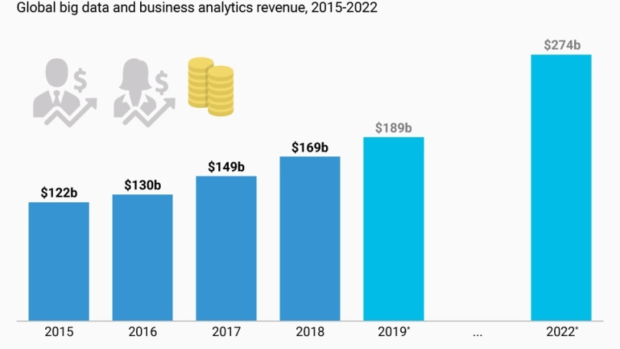
Since the onset of the pandemic, a post-Covid digital shift has significantly accelerated big data adoption. Coupled with the success of cloud technology, the big data industry has seen tremendous growth in the past five years.
Shooting up from $169 billion in 2018, to a predicted $274 billion by the end of 2022, the market has raked in a 64% increase in global investment.
As we step into 2022, one major trend driving the expansion of big data technology is the increased use of both private and public cloud services.
As consumer attitudes and buying behaviours change, there’s no doubt that the adoption of predictive analytics will be on the rise as we step into the next decade of technological evolution.
Are Marketers Looking At A Data-Driven Future?
Big data is used by pretty much every imaginable industry to some extent. From software development itself, banking and insurance to public services, manufacturing and education.
Marketers, in particular, are tipped to see a significant boost in revenue on the back of big data adoption.
Recent statistics from Aberdeen Group’s Data-Driven Retail study found that data-driven marketing approaches improved brand awareness by 2.7 times, and boosted initial investment returns by a fifth in just one year.
Enhancing a brand’s ability to create consumer-specific content, a new focus on data-driven campaign planning has set a new standard for a future of targetted advertising, predictive forecasting and optimised budgeting.
A new generation of data-driven digital marketers are interested in three types of big data adoption. Operational, consumer and financial.
While each data set is obtained from various sources, a combined intelligence made up of target audience insights, sales statistics and customer relationship management input will reward business leaders with a powerful outlook on the market and provide a competitive edge as they make business decisions.
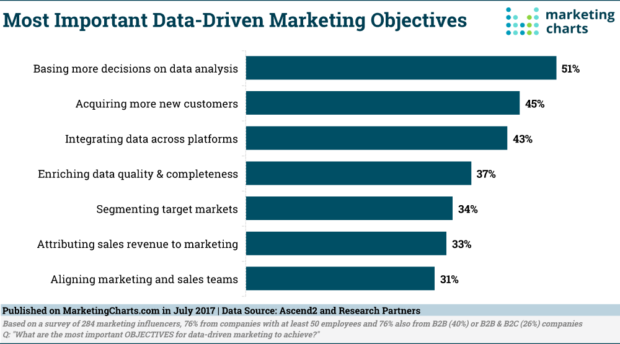
As you can see above, over half of all marketers aim to base more decisions on big data analytics in an online environment. With more digital-based consumers than ever before, a wide portion of the industry is planning to integrate data harvesting models across a wide number of social and online platforms.
Let’s have a closer look at some of the key benefits associated with the implementation of big data within a marketing strategy.
Smart Insights
“We are surrounded by data, but starved for insights,” claims Jay Baer, customer experience expert and author.
In a predominantly online playing field, a number of leading digital brands still fail to use a wide breadth of data to their advantage. In fact, one study by the Internet Of Business found that most company leaders are missing out on $5.2 million in business revenue, which is attributed to untapped data alone.
Investing in a big data solution is an easy way to take that untapped data and transform it into an insight-led plan of action. Big data is a gateway to truly getting to know your prospects. With greater access to purchasing patterns, site engagement and demographic profiling, smart marketers can use big data insights to influence their targetted campaigns and improve their consumer relationships.
In fact, the adoption of just one big data technology can increase sales by up to 60% as marketers learn to connect with their leads based on their historical search and purchase patterns.
Enhanced Consumer Targetting
With wider access to smart insights comes an enhanced consumer targeting strategy. From improving PPC advertising to creating a personalised recommendation system, big data analytics can significantly improve outreach success.
One e-commerce giant leading the way forward for smart consumer targeting is Amazon. Utilising a collaborative filtering engine (CFE), the company are able to draw on the benefits of analytic technology to gather insight into online purchasing patterns and click-based behaviour.
This information is then converted into a set of personalised recommendations for products and site services that a potential lead would be likely to engage with based on their historical purchasing data.
In turn, the e-commerce leader claims that it generated 35% of its annual conversions using the powers of big data science and the persuasive nature of targeted advertising.
Not only can a focus on consumer targeting and personalisation enhance business revenue, but the implementation of recommendation algorithms improves demographic retention in a competitive online field.
Optimised Budgeting
Big data can also improve spending segmentation as brands invest in a number of channels ranging from social platforms to mobile applications. Using the powers of big data analytics, business leaders have a transparent view of how their money is spent and which channels are raking in the highest returns.
“Business is all about tradeoffs: price versus volume, cost of inventory versus the chance of a stock-out. In the past, many such tradeoffs have been made with little data and a lot of gut instinct. Even now, in the age of cookies and click-throughs, it’s not always easy to optimize spending allocations,” claims the head of Mckinsey’s marketing return, Jonathan Gordon.
“Big Data and advanced analytics—particularly more real-time data—can eliminate much of the guesswork. One transnational communications company had spent heavily on traditional media to improve brand recognition and invested in social media as well. However, its traditional marketing-mix models could not measure the sales impact of the social buzz.”
Half of B2B marketers still struggle to measure their ROI and assign channel engagement to their revenue returns, rendering it harder to justify budgeting for campaigns. Using big data to optimise budgeting patterns, marketers receive a cost-benefit examination of all expenses and can use these predictive insights to lead future spending decisions.
Predicting The Future
While data science prides itself on producing insights in real-time, smart marketers can also utilise big data technology to aid the predictions of future demographic and industry trends.
In order to stay one step ahead of e-commerce competitors, data-driven marketers can use big data to produce automated business forecasts that influence a company’s next steps.
Big data is also improving automated response times according to Forrester. As technology gets smarter, predictive responses are becoming more common within a strategic plan in order to address increasing consumer demand.

In fact, 44% of B2C marketers now claim that improving consumer response is their main goal when investing in big data.
As we step into an automated future, consumer demand, constant digital evolution and increased e-commerce competition are some of the key factors leading to the adoption of big data technology. The question is, will a data-driven tomorrow improve strategy success, or just increase competition?
[ad_2]
Source link
About the Author