
[ad_1]
So how much of the material that goes into the typical bin avoids a trip to landfill? For countries that do curbside recycling, the number—called the recovery rate—appears to average around 70 to 90 percent, though widespread data isn’t available. That doesn’t seem bad. But in some municipalities, it can go as low as 40 percent.
What’s worse, only a small quantity of all recyclables makes it into the bins—just 32 percent in the United States and 10 to 15 percent globally. That’s a lot of material made from finite resources that needlessly goes to waste.
We have to do better than that. Right now, the recycling industry is facing a financial crisis, thanks to falling prices for sorted recyclables as well as policy, enacted by China in 2018, which restricts the import of many materials destined for recycling and shuts out most recyclables originating in the United States.
There is a way to do better. Using computer vision, machine learning, and robots to identify and sort recycled material, we can improve the accuracy of automatic sorting machines, reduce the need for human intervention, and boost overall recovery rates.
My company,
Amp Robotics, based in Louisville, Colo., is developing hardware and software that relies on image analysis to sort recyclables with far higher accuracy and recovery rates than are typical for conventional systems. Other companies are similarly working to apply AI and robotics to recycling, including Bulk Handling Systems, Machinex, and Tomra. To date, the technology has been installed in hundreds of sorting facilities around the world. Expanding its use will prevent waste and help the environment by keeping recyclables out of landfills and making them easier to reprocess and reuse.
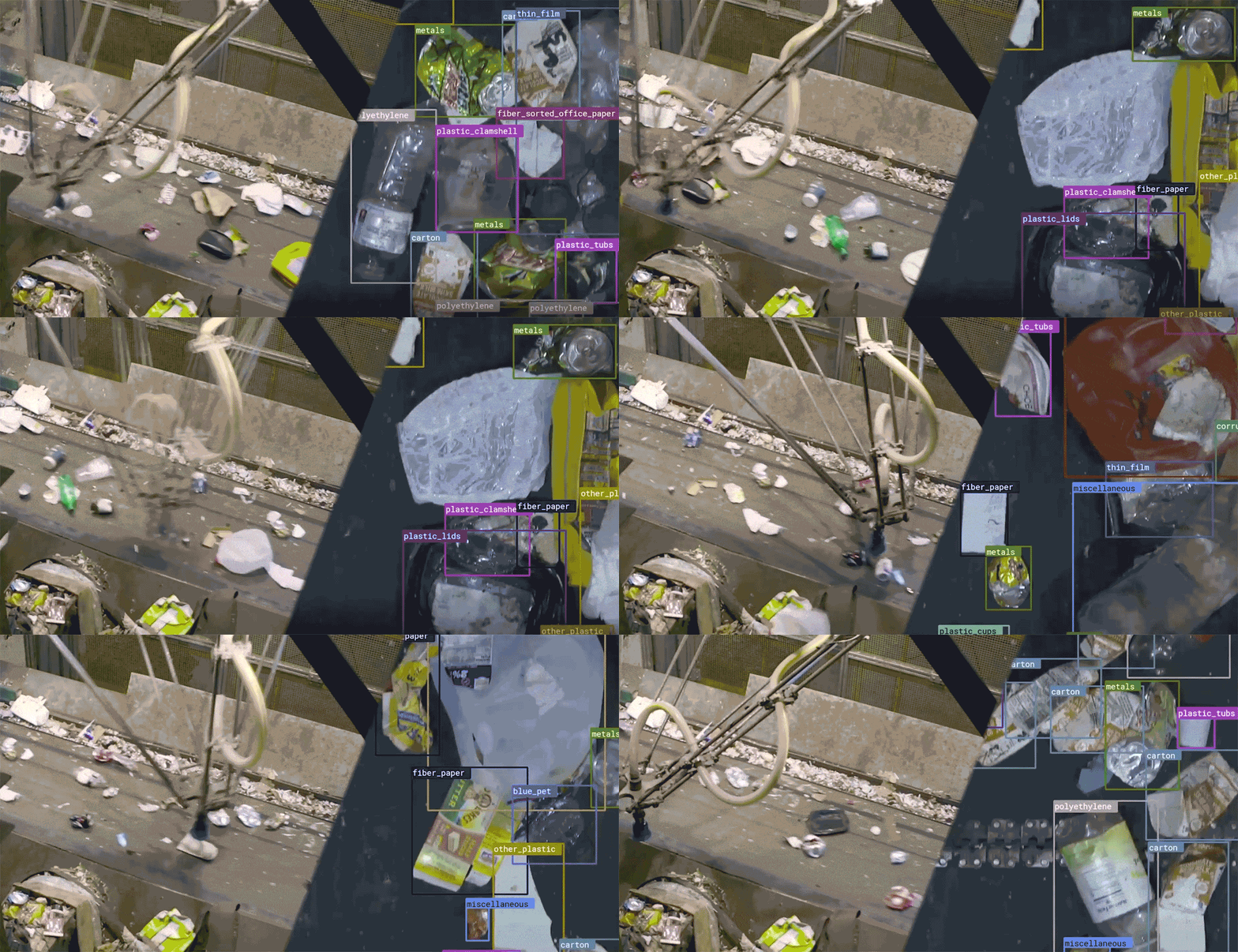 AMP Robotics
Before I explain how AI will improve recycling, let’s look at how recycled materials were sorted in the past and how they’re being sorted in most parts of the world today.
When recycling began in the 1960s, the task of sorting fell to the consumer—newspapers in one bundle, cardboard in another, and glass and cans in their own separate bins. That turned out to be too much of a hassle for many people and limited the amount of recyclable materials gathered.
In the 1970s, many cities took away the multiple bins and replaced them with a single container, with sorting happening downstream. This “single stream” recycling boosted participation, and it is now the dominant form of recycling in developed countries.
Moving the task of sorting further downstream led to the building of sorting facilities. To do the actual sorting, recycling entrepreneurs adapted equipment from the mining and agriculture industries, filling in with human labor as necessary. These sorting systems had no computer intelligence, relying instead on the physical properties of materials to separate them. Glass, for example, can be broken into tiny pieces and then sifted and collected. Cardboard is rigid and light—it can glide over a series of mechanical camlike disks, while other, denser materials fall in between the disks. Ferrous metals can be magnetically separated from other materials; magnetism can also be induced in nonferrous items, like aluminum, using a large eddy current.
By the 1990s, hyperspectral imaging, developed by NASA and first launched in a satellite in 1972, was becoming commercially viable and began to show up in the recycling world. Unlike human eyes, which mostly see in combinations of red, green, and blue, hyperspectral sensors divide images into many more spectral bands. The technology’s ability to distinguish between different types of plastics changed the game for recyclers, bringing not only optical sensing but computer intelligence into the process. Programmable optical sorters were also developed to separate paper products, distinguishing, say, newspaper from junk mail.
So today, much of the sorting is automated. These systems generally sort to 80 to 95 percent purity—that is, 5 to 20 percent of the output shouldn’t be there. For the output to be profitable, however, the purity must be higher than 95 percent; below this threshold, the value drops, and often it’s worth nothing. So humans manually clean up each of the streams, picking out stray objects before the material is compressed and baled for shipping.
Despite all the automated and manual sorting, about 10 to 30 percent of the material that enters the facility ultimately ends up in a landfill. In most cases, more than half of that material is recyclable and worth money but was simply missed.
We’ve pushed the current systems as far as they can go. Only AI can do better.
Getting AI into the recycling business means combining pick-and-place robots with accurate real-time object detection. Pick-and-place robots combined with computer vision systems are used in manufacturing to grab particular objects, but they generally are just looking repeatedly for a single item, or for a few items of known shapes and under controlled lighting conditions.Recycling, though, involves infinite variability in the kinds, shapes, and orientations of the objects traveling down the conveyor belt, requiring nearly instantaneous identification along with the quick dispatch of a new trajectory to the robot arm.
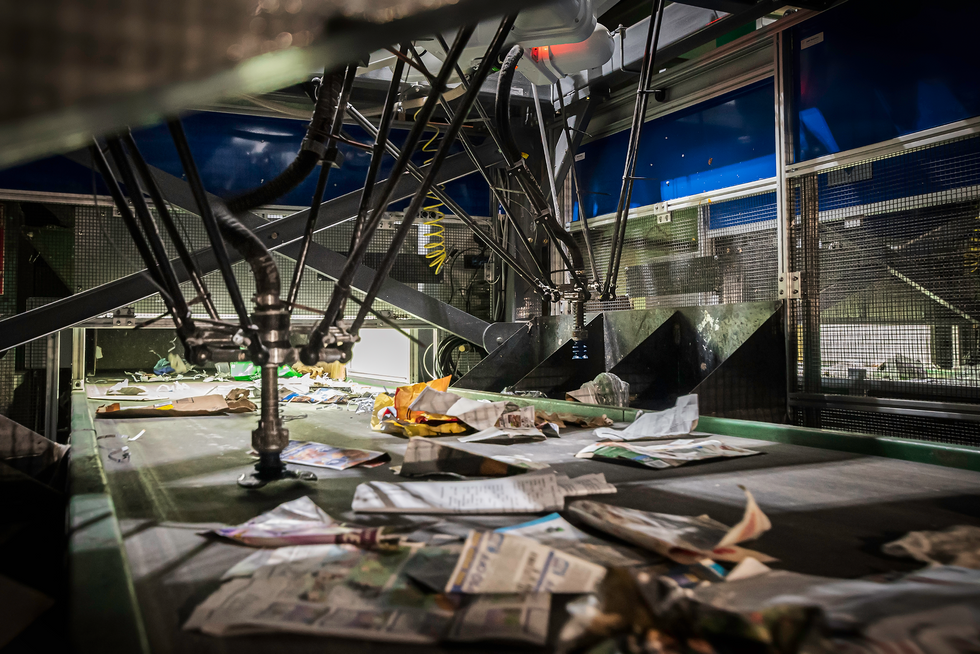
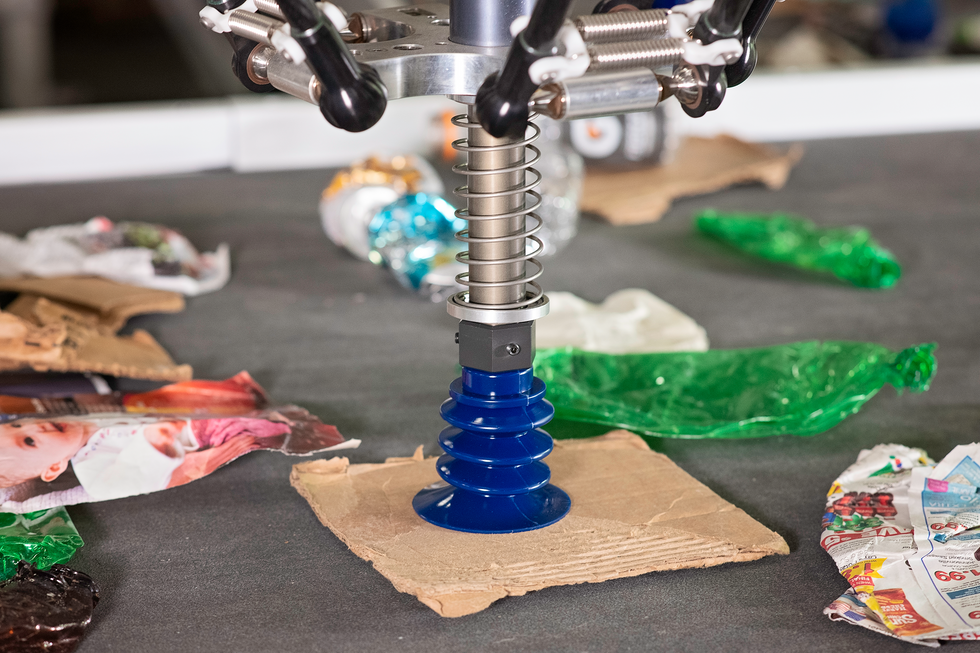 AI-based systems guide robotic arms to grab materials from a stream of mixed recyclables and place them in the correct bins. Here, a tandem robot system operates at a Waste Connections recycling facility [top], and a single robot arm [bottom] recovers a piece of corrugated cardboard. The United States does a pretty good job when it comes to cardboard: In 2021, 91.4 percent of discarded cardboard was recycled, according to the American Forest and Paper Association.AMP Robotics
My company first began using AI in 2016 to extract empty cartons from other recyclables
at a facility in Colorado; today, we have systems installed in more than 25 U.S. states and six countries. We weren’t the first company to try AI sorting, but it hadn’t previously been used commercially. And we have steadily expanded the types of recyclables our systems can recognize and sort.
AI makes it theoretically possible to recover all of the recyclables from a mixed-material stream at accuracy approaching 100 percent, entirely based on image analysis. If an AI-based sorting system can see an object, it can accurately sort it.
Consider a particularly challenging material for today’s recycling sorters: high-density polyethylene (HDPE), a plastic commonly used for detergent bottles and milk jugs. (In the United States, Europe, and China, HDPE products are labeled as No. 2 recyclables.) In a system that relies on hyperspectral imaging, batches of HDPE tend to be mixed with other plastics and may have paper or plastic labels, making it difficult for the hyperspectral imagers to detect the underlying object’s chemical composition.
An AI-driven computer-vision system, by contrast, can determine that a bottle is HDPE and not something else by recognizing its packaging. Such a system can also use attributes like color, opacity, and form factor to increase detection accuracy, and even sort by color or specific product, reducing the amount of reprocessing needed. Though the system doesn’t attempt to understand the meaning of words on labels, the words are part of an item’s visual attributes.
We at AMP Robotics have built systems that can do this kind of sorting. In the future, AI systems could also sort by combinations of material and by original use, enabling food-grade materials to be separated from containers that held household cleaners, and paper contaminated with food waste to be separated from clean paper.
Training a neural network to detect objects in the recycling stream is not easy. It is at least several orders of magnitude more challenging than recognizing faces in a photograph, because there can be a nearly infinite variety of ways that recyclable materials can be deformed, and the system has to recognize the permutations.
It’s hard enough to train a neural network to identify all the different types of bottles of laundry detergent on the market today, but it’s an entirely different challenge when you consider the physical deformations that these objects can undergo by the time they reach a recycling facility. They can be folded, torn, or smashed. Mixed into a stream of other objects, a bottle might have only a corner visible. Fluids or food waste might obscure the material.
We train our systems by giving them images of materials belonging to each category, sourced from recycling facilities around the world. My company now has the world’s largest data set of recyclable material images for use in machine learning.
Using this data, our models learn to identify recyclables in the same way their human counterparts do, by spotting patterns and features that distinguish different materials. We continuously collect random samples from all the facilities that use our systems, and then annotate them, add them to our database, and retrain our neural networks. We also test our networks to find models that perform best on target material and do targeted additional training on materials that our systems have trouble identifying correctly.
In general, neural networks are susceptible to learning the wrong thing. Pictures of cows are associated with milk packaging, which is commonly produced as a fiber carton or HDPE container. But milk products can also be packaged in other plastics; for example, single-serving milk bottles may look like the HDPE of gallon jugs but are usually made from an opaque form of the PET (polyethylene terephthalate) used for water bottles. Cows don’t always mean fiber or HDPE, in other words.
There is also the challenge of staying up to date with the continual changes in consumer packaging. Any mechanism that relies on visual observation to learn associations between packaging and material types will need to consume a steady stream of data to ensure that objects are classified accurately.
But we can get these systems to work. Right now, our systems do really well on certain categories—more than 98 percent accuracy on aluminum cans—and are getting better at distinguishing nuances like color, opacity, and initial use (spotting those food-grade plastics).
Now thatAI-basedsystems are ready to take on your recyclables, how might things change? Certainly, they will boost the use of robotics, which is only minimally used in the recycling industry today. Given the perpetual worker shortage in this dull and dirty business, automation is a path worth taking.
AI can also help us understand how well today’s existing sorting processes are doing and how we can improve them. Today, we have a very crude understanding of the operational efficiency of sorting facilities—we weigh trucks on the way in and weigh the output on the way out. No facility can tell you the purity of the products with any certainty; they only audit quality periodically by breaking open random bales. But if you placed an AI-powered vision system over the inputs and outputs of relevant parts of the sorting process, you’d gain a holistic view of what material is flowing where. This level of scrutiny is just beginning in hundreds of facilities around the world, and it should lead to greater efficiency in recycling operations. Being able to digitize the real-time flow of recyclables with precision and consistency also provides opportunities to better understand which recyclable materials are and are not currently being recycled and then to identify gaps that will allow facilities to improve their recycling systems overall.
Sorting Robot Picking Mixed PlasticsAMP Robotics
But to really unleash the power of AI on the recycling process, we need to rethink the entire sorting process. Today, recycling operations typically whittle down the mixed stream of materials to the target material by removing nontarget material—they do a “negative sort,” in other words. Instead, using AI vision systems with robotic pickers, we can perform a “positive sort.” Instead of removing nontarget material, we identify each object in a stream and select the target material.
To be sure, our recovery rate and purity are only as good as our algorithms. Those numbers continue to improve as our systems gain more experience in the world and our training data set continues to grow. We expect to eventually hit purity and recovery rates of 100 percent.
The implications of moving from more mechanical systems to AI are profound. Rather than coarsely sorting to 80 percent purity and then manually cleaning up the stream to 95 percent purity, a facility can reach the target purity on the first pass. And instead of having a unique sorting mechanism handling each type of material, a sorting machine can change targets just by a switch in algorithm.
The use of AI also means that we can recover materials long ignored for economic reasons. Until now, it was only economically viable for facilities to pursue the most abundant, high-value items in the waste stream. But with machine-learning systems that do positive sorting on a wider variety of materials, we can start to capture a greater diversity of material at little or no overhead to the business. That’s good for the planet.
We are beginning to see a few AI-based secondary recycling facilities go into operation, with Amp’s technology first coming online in Denver in late 2020. These systems are currently used where material has already passed through a traditional sort, seeking high-value materials missed or low-value materials that can be sorted in novel ways and therefore find new markets.
Thanks to AI, the industry is beginning to chip away at the mountain of recyclables that end up in landfills each year—a mountain containing billions of tons of recyclables representing billions of dollars lost and nonrenewable resources wasted.
This article appears in the July 2022 print issue as “AI Takes a Dumpster Dive .”
[ad_2]
Source link


